For agricultural operations, remote industrial facilities, and off-grid sites across Saudi Arabia, water supply has traditionally come with a significant and recurring cost: diesel. Running diesel pumps continuously to supply irrigation, livestock, or process water means constant fuel procurement, engine maintenance, and vulnerability to fuel supply disruptions — all of which compound over time into a substantial operational burden.
Solar water pumping offers a direct and increasingly practical alternative. In Saudi Arabia, where solar irradiance is among the highest in the world and where many pumping applications require water during daylight hours when the sun is generating power, the match between the technology and the application is unusually good.
How Solar Water Pumping Systems Work
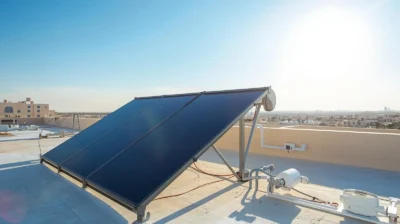
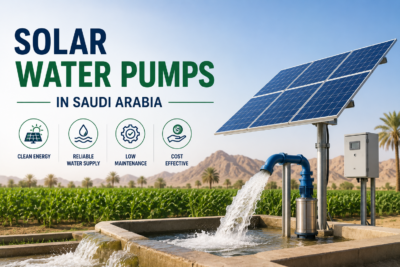
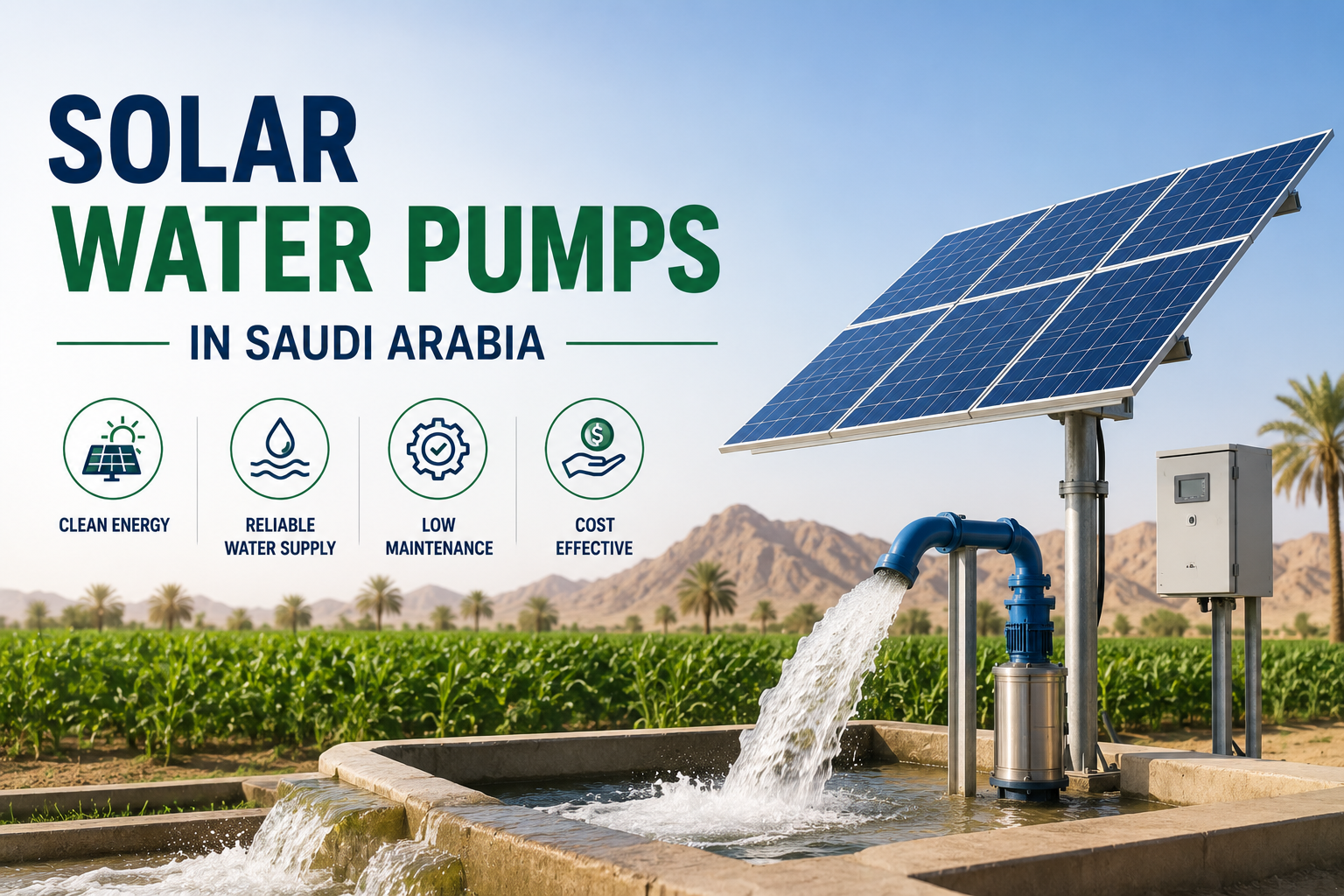
A solar water pump in Saudi Arabia operates on the same basic principle as any electrically powered pump, with the grid or diesel generator replaced by a solar array. The photovoltaic panels generate DC electricity, which is either fed directly to a DC pump motor or converted to AC via an inverter to power a standard AC pump. A variable frequency drive or maximum power point tracking controller optimises the power delivery to keep the pump operating efficiently as solar irradiance changes through the day.
For applications requiring water storage to cover periods without sun — overnight irrigation or livestock water supply through the night — the system incorporates an elevated tank or ground-level reservoir that is filled during daylight hours and drawn down as needed. This is simpler, more reliable, and significantly less expensive than battery-based storage for most agricultural and remote applications.
Agricultural Applications: Replacing Diesel on Saudi Farms
Solar panel system for farms in Saudi Arabia addresses one of the most significant recurring costs in Saudi agricultural operations. Farms using drip irrigation, flood irrigation, or centre pivot systems all require substantial pumping capacity, and the energy cost of running that infrastructure on diesel is a material line in any farm’s operating budget.
A solar pumping system sized to the farm’s irrigation schedule eliminates fuel costs for daytime pumping almost entirely. For farms in areas with good solar resources — which in Saudi Arabia means essentially everywhere — the reduction in operational expenditure is immediate and sustains itself across the system’s 20-plus-year lifespan.
The environmental case is also significant. Saudi Arabia’s agricultural sector has faced long-term groundwater depletion challenges. Reducing energy barriers to efficient water management — through precision irrigation powered by solar — supports more sustainable water use as well as lower costs.
Industrial and Remote Site Applications
Solar water pumping is equally applicable outside agriculture. Remote industrial sites — mining operations, petrochemical facilities, construction camps — require reliable water supply and have historically depended on diesel-powered pumping where grid power is unavailable. A solar water pump in Saudi Arabia at these locations reduces fuel logistics, cuts maintenance frequency, and provides more predictable operating costs over time.
For factories and manufacturing facilities with significant process water requirements, solar water pumping can be integrated into a broader solar energy strategy, reducing overall reliance on grid electricity during peak demand periods.
What a Well-Designed Solar Pumping System Requires
Sizing a solar pumping system correctly requires accurate information: daily water demand, depth to water (for borehole applications), static head for surface pumping, pipe diameter and run length, and the hours of operation required. Solar pumps service in Saudi Arabia from a capable provider will begin with this data and design the array size and pump specification around it, rather than offering a standard package and hoping it fits.
Equipment selection matters considerably in desert conditions. Controllers, connectors, and cable insulation all need to be rated for sustained high temperatures. Pumps operating in boreholes need to handle any particular characteristics of the local water — mineral content, turbidity, temperature.
Long-Term Performance and Support
Like any solar installation, a water pumping system delivers best-value returns when it is maintained properly. Our solar energy company overview covers our full range of services, and our
maintenance and upgrades services include scheduled inspections, panel cleaning, controller checks, and pump performance reviews to ensure output remains consistent year after year.
Frequently Asked Questions
How does a solar water pump work in desert conditions?
Solar water pumps in desert environments operate from photovoltaic panels that generate electricity from sunlight. An MPPT controller or variable frequency drive manages the output to the pump motor as solar irradiance varies through the day. High-quality desert-rated systems use UV-stable cables, heat-resistant connectors, and sealed electronics designed to maintain performance in sustained temperatures well above 40 degrees Celsius.
Can solar pumps replace diesel pumps on Saudi farms?
Yes, and they have done so successfully across farms throughout Saudi Arabia. For daytime pumping applications — which covers most irrigation scheduling — solar provides a direct replacement. Where night-time supply is needed, a water storage tank charged during daylight hours provides buffer capacity without requiring batteries. Hybrid systems that retain a diesel backup for extended low-solar periods are also an option for critical applications.
What maintenance does a solar water pumping system need?
Solar pumping systems require periodic panel cleaning to maintain energy output, controller and wiring inspections to check for heat or dust-related deterioration, pump performance checks to detect any decline in output or efficiency, and verification that storage tanks and float switches are functioning correctly. In borehole applications, pump pull-outs for inspection are typically scheduled every three to five years depending on water quality.
What is the lifespan of a solar water pump system in Saudi Arabia?
Well-specified and maintained solar pumping systems typically achieve 20 to 25 years of operational life for the panels and up to 10 to 15 years for pumps and controllers before components require replacement. The key determinants of lifespan are equipment quality rating for desert conditions, installation quality, and whether a structured maintenance programme is in place.
Can a solar water pump system work without grid connection?
Yes — this is actually one of the primary use cases for solar water pumping in Saudi Arabia. Remote farms, agricultural sites, and industrial locations that lack reliable grid access can run fully autonomous pumping systems powered entirely by solar. This eliminates both grid connection costs and the ongoing fuel and maintenance costs associated with diesel generation.